Alopiranosa

Altropiranosa

glucopyranose

Mannopyranose

Gulopiranosa

Idopiranosa

galactopyranose

Talopiranosa


The
sucrose is a disaccharide formedby a molecule of glucose and one fructose.
Its chemical name is:
Its chemical formula is (C 12 H 22 O 11)

is a disaccharide formed by the union of glucose and galactose. Lactose is also called milk sugar as it appears in the milk of female mammals at a rate of 4-5%. Camel milk, for example, is rich in lactose. Crystallizes with one molecule of water of hydration, so its formula is: C H 12 O 22 11 · H 2 O, then it can also call lactose monohydrate. Its molecular weight is 360.32 g / mol

Maltose
is a disaccharide consisting of two glucoses joined by a glycosidic bond between the oxygen produced the first anomeric carbon (from - OH) of glucose and oxygen belonging to the fourth carbon of the other. Therefore, this compound also called alpha-glucopyranosyl (1-4) glucopyranose alpha

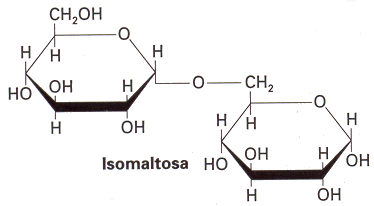
The isomaltose
The isomaltose is a double sugar (disaccharide ) formed by two glucose hydroxyl groups linked by carbon 1 in alpha position of one glucose and other carbon 6 of glucose. Thus this compound is also called alpha glucopyranosyl (1-6) glucopyranose beta . Upon binding is apparent that a water molecule and two glucoses are joined by oxygen monocarbonílico acting as a bridge. The isomaltose appears in grains germinated barley . Can be obtained by hydrolysis of starch and Glycogen. Its formula is C 12 H 22 O 11.

Trehalose
is a double sugar (disaccharide), consisting of two glucose molecules where the glycosidic linkage involves the OH groups of the two anomeric carbon. Reducing glucose from two sweets get a nonreducing disaccharide with a low sweetness. On reaching the intestine the trehalose splits into glucose by the enzyme trehalase. The absence of this enzyme causes a disease called trehalose intolerance or intolerance to mushrooms.
is present naturally in mushrooms, fungi, and insect hemolymph. Is being obtained on an industrial scale starting from cereal starch, and is being used in foods for athletes and as a filler.

cellobiose
The cellobiose is a double sugar (disaccharide) formed by two glucose units linked by hydroxyl groups at carbon 1 beta position of glucose and carbon 4 of another glucose. Thus this compound is also called beta glucopyranosyl (1-4) glucopyranose. Upon binding is apparent that a water molecule and two glucoses are linked by an oxygen monocarbonílico that acts as a bridge. The cellobiose appears in the hydrolysis of cellulose. Its formula is C 12 H 22 O 11 .


The Henderson-Hasselbalch equation is used to calculate the pH of a buffer solution or buffer, from a pK (the acid dissociation constant) and the equilibrium concentrations of acid or base, acid or conjugate base.
![pH = pK_a + \log_{10} \left ( \frac{[A^-]}{[AH]} \right )](https://lh3.googleusercontent.com/blogger_img_proxy/AEn0k_sJFbYPeXykJrY9qZVHNTaNvdJ2_7AKFn2UevZozjcP76KYfP9PuXCrdBcszTfDKgZuPRvjDLW7JLhAwi-k-QzmXeBeVOHAb38B-XIOaEm5Fh0XmUVSsE_wM82n8v6vTWTVl413x2K8IKHF2yUH=s0-d)
Derivation
Suppose an acid AH with partial decoupling. The balance is:

and associated dissociation constant will be:
![K_{a} = \frac{[A^-][H_{3}O^+]}{[AH]}](https://lh3.googleusercontent.com/blogger_img_proxy/AEn0k_vdwXkxyUYt5M8KvmUL9TrRzqiVQsDg76eSxU3dBey6yoWAmsHWLKm7vqu-8AufxjoLeATFbonTU38yJD5Fpqcc-hslasFsgdQhboMma4ONFdN1QUFpEeK9k4g3I-j8J3f8KO0FQHK9VU3lJCU=s0-d)
Solving [ H 3 O +] of the constant Dissociation:
![[H_{3}O^+] = \frac{K_{a}[AH]}{[A^-]}](https://lh3.googleusercontent.com/blogger_img_proxy/AEn0k_tHAbEBgqVw3RAabZg44qAUuvWGyHNnOHYGY-70Hdz1dEtt_MxURaVzr3gs_L92VvtfwZfePhPOIZbhTRXgraQelDywNdtvlme3qzMtZppnghPW2LFkptk-LurhhUM_INHBeNER-rzPt4099bGwcw=s0-d)
Taking logarithms on both sides and applying the property of logarithms to a product we get:
![- \log_{10} \left ( [H_{3}O^+] \right ) = - \log_{10} \left ( K_{a} \right ) - \log_{10} \left ( \frac{[AH]}{[A^-]} \right )](https://lh3.googleusercontent.com/blogger_img_proxy/AEn0k_sVWq8UP2uvgrJMpXCG_-nNx8UlbWPc1Z1KCrVKUd3oywqhVLrYbmxRD-9-qirZLhZfQj3UKSobJOSrECqZkQimeIhhzos_fiEflMvnyVKuT36t-w5wx4Pox79BptDqlB7NVwodoj_UCBzfhsP5RA=s0-d)
E ratio:
![pH = pK_{a} + \log_{10} \left ( \frac{[A^-]}{[AH]} \right )](https://lh3.googleusercontent.com/blogger_img_proxy/AEn0k_swG2bUDMn2wUt7qoq1Aw_p4rWhUI8JdKdm84XretUlM2jCy7_PRVPOI-28OuKkj8v2ZJTtEGZGqKFNwtrT37nL3AtB4Dqa1SXXh_K52Vfk56hRMfig9CeRCFH3aDYVQ-pCKtM0f6QKgVdV65BCwQ=s0-d)


The molarity (M ) is the number of moles of solute per liter of solution. For example, if 0.5 moles of solute dissolved in 100 mL of dissolution, that has a solute concentration of 0.5 M (0.5 molar). To prepare a solution of this concentration is usually first dissolved solute in a smaller volume, eg 30 mL, and transferred this solution to a volumetric flask, then fill it with more solvent until 100 mL.

is the most common method of expressing chemical concentration especially when working with chemical reactions and stoichiometry. However, it has the disadvantage that the volume changes with temperature.
The molality (m ) is the number of moles of solute per kilogram of solvent. To prepare solutions of a given molality in a solvent, not a volumetric flask is used as in the case of the molarity, but can be done in a beaker and weighing with an analytical balance, weight empty glass before so that we can subtract the corresponding value.

The main advantage of this method of action on the molality is that as the volume of a solution depends on the temperature and pressure, when they change, the volume change with them. Because the molality is not a function of volume, is independent of temperature and pressure, and can be measured more accurately.
used is less than the molarity. Normality
The normal ( N ) is the number equivalents (n ) of solute ( st) per liter of solution (sc ).

is the normality of a solution when used for a reaction as an acid or base. For this usually titrated using pH indicators.
In this case, the equivalent can be expressed as follows:
 for an acid or base
  for.
for. Where:
For this, we can say the following:
 for an acid or base
  for.
for. Where:
Examples:
In this case, the equivalent can be expressed as follows:
 .
. Where:
For this, we can say the following:
 .
. Where:
Examples:

The hydrogen bond is a bond that exists between molecules capable of generating partial loads. Water is the substance in which hydrogen bonds are more effective in its molecule, the electrons involved in their blogs, are closer to the oxygen of the hydrogen and thus generates two negative partial charges at the end where is the oxygen and two partial positive charges at the end where the hydrogens. The presence of positive and negative partial charges causes water molecules to behave as magnets in which parties with partial positive charge attracts the negative partial charges parties. In such a way that a single water molecule can bind to other 4 water molecules through hydrogen bonds 4. This characteristic is what makes water special liquid.
hydrogen bonds are formed by hydrogen atoms located between electronegative atoms. When a hydrogen atom is bonded covalently , an electronegative atom, eg . oxygen or nitrogen, assuming a density ( d) positively charged due to the high electronegativity of the neighboring atom. This partial deficiency of electrons, causes the hydrogen atoms capable of attraction by the unshared electrons on oxygen or nitrogen atoms
Note the settings Electronic Oxygen
8 O 1s 2 2s 2 2px ê é p é pz é
of Hence
d + d +
d -
+ d + d
d -
Figure: electron configuration of oxygen
the hydrogen bond is relatively weak between -20 and -30 kJ mol -1 , bond strength increases with increasing electronegativity and decreases with the size of atoms participants. Therefore, hydrogen bonding exists in many molecules not only in water. This deal only with regard to the water.
promotes water structure interactions to form hydrogen bonds is always perpendicular arrangement between the molecules involved, is also favored that each proton attached to a very electronegative Oxygen is an unshared electron that interacts with one by one. It is confirmed that each atom d oxygen in the water interacts with 4 protons, two of them together and two covalently through hydrogen bonds.
collinear
Figure: Information on hydrogen bridges
Studies X-ray diffraction indicate that the distance between oxygen atoms involved in hydrogen bonds are separated by 0.28 nm indicating a tetrahedral arrangement of water molecules also hydrogen bonds:
TETRAHEDRO
Figure: A representation of a tetrahedral molecule of water.
The collinearity of the bridges is very important, a distance of 10 ° causes the bridge to break.
linnus Pauling postulated from observations of molecular transitions (ie the motion of atoms with respect to those who are attached) of the participating atoms in the molecule D 2 O (deuterium is part of the constellation of hydrogen), the hydrogen bond interaction is more important than playing a critical role not only in the structure of water but in the structure and function of biological macromolecules.